Roger Tory Peterson

Yesterday, August 28, was the 105-th anniversary of the birth of Roger Tory Peterson one of the most influential naturalists of the 20-th century.  Born in 1908 in Jamestown New York, his first book, Field Guide to the Birds was published in 1934 when he was only 26, and helped make bird identification accessible to the general public.

The Roger Tory Peterson Institute (RTPI) was founded in Jamestown to continue his work.  Their website has a excellent short biography of RTP which highlights his accomplishments and shows just how important his work was to the environmental movement of the 20-th century.

Links

Roger Tory Peterson Institute of Natural History (RTPI): Biography of Roger Tory Peterson.

BirdNote: Happy Birthday, Roger Tory Peterson.

UK’s Blogging Red Kites

Blogging Birds is the name of a web-site run by a group of researchers at the University of Aberdeen in Scotland in conjunction with members of the RSPB (Royal Society for the Protection of Birds). The site’s byline, The lives of red kites, told by computers, sums up what the site is all about.

Red Kites 5 (5939879892) The Red kite is a species of raptor that, according to the web site, was once widespread in the UK and, after having been almost extirpated (down to 10 breeding pairs in Wales in the 1940’s) is making something of a comeback.

What the researchers have done is to fit several birds with satellite transmitters that provide accurate positions for the birds several times per day. These can be plotted on a map which anyone can see online. So far, pretty cool, but there’s more!

In addition to the geo-tracking, the researchers have linked in information from other databases that tell them about the areas visited by the birds. They know if an area is urban or rural and, based on land use information, can guess at how a bird might be feeding itself. They also know when a kite is near its home turf or if it is exploring far outside its normal range. Finally, if their path crosses that of one of the other tracked kites, they have information about their possible interactions with others of their species.

The final piece that let’s them create blog postings on behalf of the kites is something called Natural Language Generation which synthesizes all the data with known kite behaviour and spits out the weekly computer generated postings that anyone can see. Looking at the web-site today I see that they have four blogs on tap for the kites: Wyvis, Moray, Millie and Ussie. There appear to be other tracked kites as well with one of them, Beauly, mentioned in Millie‘s latest post for the week of August 12 to 18.

It will be interesting to follow one or more of the kites over longer periods of time. Perhaps these blogs can help to reduce the animosity that once almost led to the Red Kite’s extirpation from the British Isles.

Notes

Of the three most common North American kites, the Red Kite is closest taxonomically to the Mississippi Kite of the south-eastern US sharing the same sub-family (Milvinae) but different genera. The White-tailed and Swallow-tailed Kites are both from a different sub-family (Elaninae). All of these kites are from the family Accipitridae of diurnal birds of prey.

The related species of Black Kite is sometimes seen in England, usually during migration. Both it and the Red Kite are from the same genus Milvus and have been known to hybridize.

Birding Song Parodies by Young Birders

A couple of mornings ago, I came across the following ABA blog post by ABA president Jeff Gordon: Ladies and Gentlemen, LIVE from Camp Avocet…Pish & Twitch!!!. For anyone who likes birding and musical parodies it’s worth a listen (I missed breakfast and was almost late for a dentist appointment trying to make it through the YouTube links).

In a nutshell: Camp Avocet is an ABA run summer camp for young birders and Pish & Twitch is a musical duo newly formed by two of the campers Caleb and Brendan. Following a long tradition in song parody, they took well-known tunes and replaced the lyrics to poke fun at, in this case, birding and birders. Five songs were recorded and can be found on YouTube, through the links in Jeff’s article.

The first three songs (in posted order) used contemporary tunes the only one of which I recognized was their second song “Moves Like Jaeger” which was obviously a parody of the Maroon 5 and Christina Aguilera hit “Moves Like Jagger”. The other two tunes were lifers for me once I made identifications with the help of my phone’s SoundHound app.  The first song “Chase Me Maybe” about going after rare bird sightings, covered “Call Me Maybe” by Carly Rae Japsen and the third tune, about night-time bird call identification, “Flight Calls”, used the melody (if you can call it that) from “Thrift Shop” by “Party DJ Rockerz”.

The final two songs were based on well known hits from my own youth. The first of these was “Migrants Go By” sung to the Don Mclean hit “American Pie”. Impressively, they covered the 8-plus-minute long version and not one of the shorter radio-friendly variants. And finally, the song, “Bill Stewart”, clearly aimed at all of the camp leaders, was sung to the Billy Joel hit “Piano Man”.

It wasn’t what you might call a ‘tight’ performance as they had obviously bitten off more than they had time to practice for but that did not seem to detract from the energy in the room.  Besides, the hard part of a parody is crafting the lyrics and there they did some excellent work.

If you are a part or or even just familiar with birding culture then you will probably enjoy listening to Pish and Twitch.

Sandhill Crane Adventure at the Reifel Bird Sanctuary

Squawking Sandhill Crane(for J & C – You know who you are!)

Last Sunday I went to the George C. Reifel Migratory Bird Sanctuary in Delta BC.  I spent about 3 hours wandering around watching birds and taking pictures of anything interesting. In the end, however, about two-thirds of the pictures were of Sandhill Cranes.

It wasn’t that there were hundreds or thousands of them and almost nothing else – in fact, there were only about a dozen or so I never saw more than 4 in a group. No, the real reasons that I took so many Sandhill Crane pictures were that:

  • Several of the cranes were relatively tame and did not fly away when I approached.
  • It is a lot easier to take pictures of a crane than a chickadee.
  • The cranes were in my way, blocking the path in the direction that I was going.

One quick side comment:  During my visit I watched people feeding both cranes and chickadees right out of their hand (the chickadee had to land on the hand first which – obviously – the crane did not do).  Personally, I would feel safer feeding the chickadee. Up close, a crane bill looks like it can deliver a pretty hard poke.

Anyways, when I showed up at the sanctuary, I didn’t really expect to see Sandhill Cranes at all. I had been there a week earlier with a photography group that I recently joined and we had only heard a single crane calling (which we didn’t even get to see). Imagine my surprise when, walking one of the paths through the middle of the sanctuary, I ran into a group of cranes along the path ahead of me. Here are two of them:
Sandhill Cranes

These two were but half of a posse of 4 adult birds blocking the path. Here are 3 of them checking me out. You can just see the fourth hidden behind the foliage on the right.
Sandhill Cranes

I must not have been very threatening as they proceeded to turn their backs and head back along the path in the direction that I was hoping to go (though I would have preferred a less leisurely pace).
Sandhill Cranes

I finally made it around the bend in the path.

Hey, nice ‘digs’!

Apparently they were squatting in one of the prettiest parts of the sanctuary.
Sandhill Cranes

All I needed to do was get past these three who did not appear to be paying me much attention.  How about along the edge of the pond?
Sandhill Cranes

Hey! You’re not cranes! This story is supposed to be about cranes!  Still, pretty cool. It was two mallards, one leucistic (missing some pigment making them look white – not albinism though).
Leucistic Mallard ?

Anyways, back to sneaking past the cranes…

Drat! Spotted!

They may seem tame but there’s no point in getting too close. Time to backtrack and go around.
Auto Tone-1030316

I turned back and went up the North edge of the sanctuary past the viewing tower. I watched some Dowitchers and Yellowlegs on my way by one of the larger ponds and then headed South briefly spotting my nemesis bird, the Marsh Wren, who was no doubt sticking his tongue out at me as he dove into the long grass.

I had walked most of the way down the West edge of the sanctuary when I encountered 2 more cranes, even friendlier than the first 4. The crane on the left was cleaning up a spot on the ground where I suspect someone had dropped a handful of crane-food – some kind of coarse seed mixture. The crane on the right was keeping an eye out – whether for threats or treats was unclear.
Cranes blocking the path

What was obvious was that they were quite tame allowing me to get close – really close.
Crane (with Long Grass)

This must be a good snacking spot. At one point a trio of people showed up and one of them offered the cranes a handful of something – more crane kibble probably – that they seemed to like a lot as they took it straight out of the person’s hand.

I imagined the crane thinking: “A teensy nip, he drops the goods and no-one gets hurt” (or is that “hoit”?).
Cleaning up after messy humans

So maybe it was an ambush spot too! There we were, blocked by a pair of ruthless sandhills forcing all passers-by to empty their pockets.

There was no way that I was giving up my bag of cashews.

Lucky for me, there was a distraction – a group of three sandhills flew overhead heading out into the marsh that separated the sanctuary from the open water of the Strait of Georgia.
Sandhill Cranes in Flight

A short time later, a second group of 4 flying cranes appeared. This group, however, let out a group call as they passed overhead. I must say, these are pretty loud birds with quite a bit of lung-power behind their calls. It was clearly some kind of message because the two birds not 10 feet ahead squawked in return.
Crane Duet 3/5

They got in a couple of rounds of noisy calls before the flying group were out of range.  It was an award winning performance.

Envelope please!

… and the winner of the Squawky goes to …
Crane Calling

The squawking was over and the people with crane-kibble in their pockets had left.  I finally slipped by and headed for the exit and that was the end of my Sandhill Crane Adventure.

More on Sandhill Cranes at the Sanctuary

The Sanctuary has resident Sandhill Cranes that live there year round (and has had for about 30 years).  While other groups of cranes will come and go, when the breeding season comes around only the resident pair will remain to nest and try to raise a family.  Last year (2012) they had one chick that unfortunately died.

The sanctuary has lots more pictures and information on their Sandhill Cranes page.

Glorious Twelfth or a Hen Harrier’s Bad Day

For some, August 12 is a special day in Great Britain. It is the start of the hunting season for the Red Grouse, king of the game birds, as fixed by parliament in the Game Act of 1773. The day proudly bears the title of the Glorious Twelfth and, unless the supply of birds runs out, the hunt continues until December 10 (November 30 in Northern Ireland).

Red Grouse – King of the Game Birds

Red Grouse (Lagopus lagopus scoticus) - geograph.org.uk - 446843

Red Grouse : Trish Steel [CC-BY-SA-2.0], via Wikimedia Commons

What gives the Red Grouse its royal title?

First, it is the only game bird that is endemic to the British Isles and can be found throughout Ireland, Scotland, Wales and Northern England with some territory extending into England’s southwest.

Second, a flushed Red Grouse bird can reach speeds of over 70 mph (I have seen 80 and even 90 mph used in different sources). The greater the speed, the greater the challenge to the hunter, particularly during the pinnacle of game hunting – the driven hunt.

In the driven game hunt, a row of 8 to 10 guns (the hunters) line up a certain distance apart, each in their own butt or stone box which provides some shelter, protection and concealment. The guns face in the direction from where a volley of Red Grouse, flushed by a line of beaters, will appear. The gun is now confronted by some number of birds, between a pigeon and a mallard in size (a typical weight is 600 g), coming at them usually low to the ground and fast enough to break the speed limit on any public road in Great Britain or Canada. The hunter’s task is to shoot as many of them as he can without injuring either beater or neighbouring gun. In principal, the hunt can continue in this manner all day long. Some historic hunts have seen enormous bags consisting of several thousand birds. There are reports of a single hunter shooting over 1000 birds in a single day. In today’s hunt, bags of 50 to 200 brace (1 brace = 2 birds) appear to be more typical for a line of 8 to 10 shooters during a day of driven hunting.

[A fascinating historic account of a driven hunt during the late Victorian Era can be found in the section on Grouse and Partridge Driving in the 1903 book Horses, Guns and Dogs.]

The hunters that come to the grouse moorlands for the challenge of shooting at these feathered-rockets make an important contribution to the economic activity of many communities where the appropriate conditions exist. The traditional grouse hunt that attracts the hunters has evolved a sophisticated management system that has the primary goal of maximizing the number of Red Grouse that are available for the shoot. There is much tradition and etiquette that comes with the today’s driven hunt, most of which are still run from private estates.

This year, the cost to participate in a driven hunt runs in the neighbourhood of £130 per brace with the expectation of a full day’s participation (I determined the cost from various sources including the Guns-on-Pegs web site which specializes in buying and selling shooting days). That works out to over C$100 per grouse. Because of the huge overhead required to hold a driven hunt (this article in the Journal of Applied Ecology gives a good accounting of this) they are very expensive to run and many estates are barely breaking even or losing money even in good years.

There is a second less expensive form of hunt referred to as the walked-up hunt in which a small group of hunters led by pointers, walk the heather shooting grouse as they are flushed by the dogs. Per brace, a walked-up hunt appears to cost roughly half that of a driven hunt.

Tradition and the Grouse Moorlands

Heather moorland near Tom Tallon's Crag - geograph.org.uk - 1508818

Heather moorland near Tom Tallon’s Crag (Andrew Curtis) / CC BY-SA 2.0
Much of the land here is managed as grouse moor as can be seen by the patchwork of areas on the far hillside where heather growth is regulated by controlled burning.

The Red Grouse does not lend itself to direct management through domestication as do other species such as partridge and pheasant. Instead, maintaining their populations is handled indirectly through the intensive management of the heather moorlands – also referred to as grouse moorlands or simply grouse moors. This lack of direct control means that the hunting season can vary in quality from year to year and location to location depending on weather conditions, predator populations, heather beetle infestations, and disease.

Managing the heather moorlands for grouse is very expensive and requires continuous attention. Gamekeepers will go to great lengths to ensure a large supply of healthy grouse, even walking the moors at night with a flashlight medicating any grouse that they find to help them fight or prevent disease. It should then come as no surprise that the same intensity is applied to managing the grouse’s predators. This usually means eradicating any predator that strays onto the grouse moors. The Red Fox may be hunted at night using lights and high-powered rifles or simply by using of snares. Widely acknowledged to be cruel and banned in most European countries, snares are also prone to catching and killing non-predators and protected species such as the badger (see for instance this 2004 article from Wales online).

Viewed from this side of the Atlantic, this ritualistic hunting supported by intense year-round management could seem odd, even barbaric. Long-standing traditions that are part of the fabric of a country’s cultural heritage can be very difficult to change.  In some cases, however, change does occur. One example is the ending of the fox hunt in Scotland, England and Wales between 2004 and 2005.

Before passing judgement, consider some of the positive aspects of the grouse hunt as put forward by proponents of the hunt.

In Great Britain organizations such as the British Association for Shooting and Conservation, the Game and Wildlife Conservation Trust, and others seem to play a similar role for game hunting as Ducks Unlimited does in North American in support of duck and goose populations. In the case of the grouse, they help promote and maintain the heather moorlands for the benefit of the game birds and for any other bird or animal that may benefit as well.  This includes, for instance, regular burning of patches of heather to keep larger shrubs in check and to encourage younger, tender growth that appeals to the grouse. One of the biggest benefits to the moors is from the reduced number of predators. Several threatened migratory birds breed in the moorlands and in those areas without these predators they thrive with breeding success reportedly 2 to 5 times that on unmanaged moorlands (as most pro-hunt organizations are quick to note).

The Game and Wildlife Conservation Trust has the following goal on their web site:

We promote our work to conservationists, including farmers and landowners and offer an on-site advisory service on all aspects of game and wildlife management, so that Britain’s countryside and its wildlife are enhanced for the public benefit

I suspect that the public benefit they refer to is a select part of the population that benefits from the hunt (the hunters, land-owners and surrounding communities). The benefit to the migratory birds is a convenient side-effect. Meanwhile, those other animals, the predators, that were removed or killed are not mentioned except in so much as they are part of the problem being managed.

The Plight of the Hen Harrier
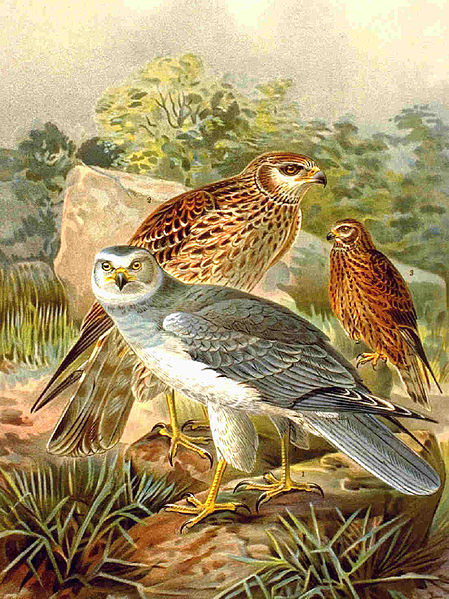
Hen Harrier

Hen Harrier (from the Wikimedia Commons)

An key part of grouse management involves predator management. According to research used by some of the shooting proponents, the survival of grouse and other species can be several times greater when predators are kept under control. For the unprotected predators such as the red fox, carrion crow, stoat or weasel this is a death sentence should they be caught on or near grouse lands.

A number of raptors also fall on a gamekeeper’s list of predators however most of these are protected species making it illegal to kill them or disturb them while nesting.  With tradition, jobs and large sums of money on the line it is not surprising that the battle lines are drawn between the gamekeepers and other hunting proponents and the ‘raptor lobby’.

[Some interesting insight into the ‘Raptor Lobby’ can be obtained from the Raptor Persecution Scotland blog.]

When discussing Red Grouse management and raptors, one species that is frequently mentioned is the Hen Harrier (Circus cyaneus; the Northern Harrier in North America).  The moorlands are a terrain well suited to their hunting and nesting behaviour yet, despite the laws intended to protect them they are disappearing in many areas of Britain particularly those areas near grouse moorlands.  They and several other raptors including Golden Eagles and Buzzards are frequently shot or poisoned.

This year in England is especially ominous for the Hen Harrier. An August 9th article by the Royal Society for the Protection of Birds (RSPB) entitled: Hen harrier on the brink of ‘extinction’ in England reports that this is the first year since the 1960’s that the Harrier has not successfully nested in England (they mean ‘extirpation’ not extinction of course).  The Hen Harrier, once widespread in Britain, has been harassed by gamekeepers for centuries.  It was previously extirpated around 1900 only to resettle mid-century.  Despite the raptor protection laws, the return to England is proving to be short lived and its future status may be uncertain as long as the economic value of the grouse hunt remains high. Given the economic importance of the grouse hunt, it is hardly surprising that Harriers and other protected raptors are being persecuted.

On the side of the hunt, a 2009 article in the Journal of Applied Ecology, Hen harriers and red grouse: economic aspects of red grouse shooting and the implications for moorland conservation, presents ecological and economic arguments to justify keeping Harrier populations low. It provides good insight into the economics of the grouse hunting industry and the issues facing the Harrier and other grouse predators.

Other opposing research is not as quick to blame the Harrier and other predators but instead lays out a number of other reasons for long term and year-to-year declines in grouse populations including:  conversion of heather moorlands to sheep pastures; deterioration in the heather quality that grouse rely on for survival; increased disease reducing survival rate; increased predation by foxes and crows attracted by increased sheep populations; afforestation; and so on.

In an effort to find real solutions, both sides of the debate have cooperated in some long term research projects to better understand the relationship between grouse populations and raptors such as the Hen Harrier.  A Joint Raptor Study (JRS) was run from 1992 to 1997 to measure the scale of raptor predation on grouse and the effects that would be felt on the hunt.  A new study called The Langholm Moor Demonstration Project started in 2008 and will last up to 10 years with the goal of finding solutions to solve the grouse-raptor issues.

I won’t go into all the details of these studies but one interesting thing that I did learn which shows some of the complexity of the problem, is that the Harrier’s main prey are voles and meadow pipits, not the grouse, and the availability of these influences where the Harriers decide to settle in the spring.  It is only during the months that they are breeding that grouse chicks are at risk of being taken and diversionary feeding (providing carrion to the raptors) has shown the numbers of grouse chicks taken to drop by as much as 86%.

Watching the Magician’s Other Hand

One fact which nobody disputes is that grouse are good for the environment.

That’s a direct quote from an obviously pro-hunt 1996 article published in “The Independent” and accurately sums up the position taken by most pro-hunt organizations.

Having spent some time trying to understand the history, culture and economics surrounding the grouse hunt in Great Britain, I can’t help feeling like I am watching a magician doing an elaborate trick when trying to sort through the shooters’ arguments.  While their main hand attempts to capture my attention with statements of environmental and economic goodness, there other hand is quietly doing whatever it takes to make sure the grouse are ready on August 12.

The arguments for and against the grouse hunt and predator management are many and, sitting on the other side of the Atlantic, I don’t feel qualified to mark the scorecard.  Instead, I will direct my final thoughts in a different direction going back to what drew me to write this in the first place, the name given to the opening of the Red Grouse hunting season.

Introspection

They call it the Glorious Twelfth.

Being a long-time fan of Star Trek the word glorious makes me think of the Klingons, warriors with tradition and a code of honour, their battles gloriously fought against enemies that are, they hope, worthy adversaries.  The grouse hunt certainly has its tradition, however  I wonder if a Klingon would feel glorious standing in a box waiting for someone else find and deliver their quarry to them, killing wave after wave of them with no chance of the quarry fighting back, the biggest risk coming from a neighbouring hunter?  I wonder if they would feel any honour participating in a sport for which so many foxes, crows, stoats, weasels, other predators and even innocent creatures that had been killed, sometimes cruelly, in order to ensure the maximum number of grouse for the final slaughter?

The Glorious Twelfth doesn’t really do the day justice.  Perhaps, as suggested by the birder and blogger Alan Tilmouth from Northumberland, a better name would be Hen Harrier Day.

References and Other Interesting Links

Some of the interesting links that I found while researching this article are given below.  Some were used directly for information while others are just interesting reading.

Glorious Twelfth

Hunting

Shooting Trip Providers

In the Press

Game Conservation

Grouse, Hen Harriers and other Birds of Prey

Songbirds in the City

The Smithsonian Institution is more than just a museum.  According to their own information they consist of a total of 18 museum’s and galleries as well as the National Zoo.  One of the organizations associated with the National Zoo is the Migratory Bird Center founded in 1991 with a goal of “fostering greater understanding, appreciation, and protection of the  grand phenomenon of bird migration“.

In a recent posting (Smithsonian Scientists Discover That Urban Songbirds Adjust Their Melodies to Adapt to Various Elements of City Life), Sarah Bloom Leeds describes the results of some research carried out by scientists at the Migratory Bird Center on how songbirds adapt their songs and calls in a noisy urban environment.

Birds use sound to communicate and their survival often depends on it.  Their songs, usually only given by the males during the breeding season, are used to find a mate and to define and defend territory.  Calls allow a bird to communicate with other birds, usually of the same species.  The alarm call, for instance, is an important way in which a bird seeing an approaching predator or other threat can quickly let all of their friends know.

In an urban environment, any person with a good sense of hearing knows how hard it can be to communicate over when noise levels are high.  We adapt by changing our voice – usually just raising the volume.  Birds, perhaps not surprisingly, have also learned to adapt their sounds to the noisy environment as well since their survival may depend on it.  The level of adaptation is, species dependent.

The article goes on to describe how some birds will raise the pitch of their songs where there is a significant (low-frequency) background noise level.  On the other hand they will lower their song frequency when reflections off of hard surfaces (e.g. buildings) distorts the sound, an effect more serious with higher frequency sound.  Apparently when both effects are present, many birds can have a much harder time adapting.

It’s a fascinating article on bird behaviour and adaptation.  The best part of Sarah’s post, however, are two sound recording links for a Carolina Wren from both an urban and a rural site.  You can clearly hear that the bird singing in the urban setting has a much smaller dynamic range: the lowest urban frequency is about 700 Hz higher than the lowest rural frequency while the highest urban frequency is about 1600 Hz lower than the highest rural frequency.

For those wanting to know more, there is a link to the original research published in 2011 that can be downloaded for free in either HTML or PDF format.

Going Out “Loaded for Bird”

A couple of days ago, I had a morning errand to run that was a short walk from our house. I put on my walking shoes and chose a path that would lead me through a section of nearby parkland that is one of my favourite local places to see a bit of nature.  This time of year that can include bears and coyotes as well as various types of birds.

I had barely gone a few steps into the wooded area when I heard a strange call. It sounded like a Robin but with a twist that I had not heard before. I spent a couple of minutes listening and moving around to triangulate the sound before I finally found its source.

A juvenile Robin, still with fully spotted breast, was hidden in plain sight in the leaf litter a scant 8 or 10 feet away.  The young bird seemed confident in its invisibility and was chirping away despite my presence.  With my camera and recording equipment, I would have been able to take some good close-up pictures and one or two good clear bird-call recordings.

On my way home, I returned past the same location with the hope that the bird might still be around. I thought that I heard the same call further into the thick undergrowth however there was no chance of seeing the bird this time.  To make matters worse, the previous quiet was now broken by the sounds of garbage truck, skill-saw, a small plane overhead and someone practicing the flute.

If you were looking for a moral to this story you might come up with:  When nature offers up an opportunity for a good nature sighting, you had better be loaded for bear with all your technology by your side and ready to go.  Mother Nature does not, after all, pass out many mulligans.

In my case, this would entail me packing my Canon binoculars, a Panasonic FZ200 camera and a digital voice recorder with a small shot-gun microphone.  Unfortunately, my frustration at having left my gear at home led me to forget that I had my iPhone in my pocket which, in the current circumstances, would have taken an acceptable sound recording and, despite its lack of zoom, an acceptable picture of the young Robin.  Abusing the previous metaphor:  I may not have been loaded for bear, but I was certainly loaded for squirrel.

In many situations, however, the iPhone won’t cut it.  The question then is what to have in the emergency birding kit?  What do you throw in the glove-box or a knapsack or even a large pocket for those non-birding excursions, just in case?

Once upon a time the answer was easy:  Binoculars.  Cameras required film which cost real money and seeing the results could take several days unless you developed your own film.  As digital technology improves and more people are collecting pictures and sound-recordings, there are other possibilities.  My current kit consists of my FZ200 camera, one of the current generation of super-zoom or bridge cameras, and that’s pretty much it.  They are lighter than my binoculars, about the same size and, with their 24x optical zoom, a reasonable substitute as well.  The image stabilization is reasonably good so that a tripod is usually not required.  Mind you,  I frequently bring my sound recorder and microphone as well because of their small size.

I’ll get over the missed opportunity with the Robin.  However, the next time I’m running out the door, I will consider more carefully whether or not to bring my emergency gear – just in case.  If anyone asks why I’m carrying it, I’ll just tell them that I’m loaded for bird.

UBC Botanical Garden

Sunday, July 28, 2013

JC had a Groupon for the Canopy Walk at the UBC Botanical Garden and Centre for Plant Research that was about to expire.  So, without the dogs in tow, we hopped in the Jetta and headed west.  If we arrived early (they open at 10:00) we figured that we could get in and do the canopy walk before any crowds arrived and lineups formed.

We followed the route provided by our iPad and iPhone devices which got us to the UBC campus without any problems.  There was a triathlon being run that day resulting in road closures including the one indicated on the map.  After a little angst and a quick check of the Garden’s website we found the parking lot and geared up.

The first thing that we noticed was a group of Bald Eagles, 1 or 2  adults and at least 4 immature birds, flying around, chasing each other and doing acrobatics.  I assume that it was part of the learning process for the younger birds.
Eagles at PlayEagles at PlayWe watched them for a while, while I tried, mostly unsuccessfully, to get some pictures of the fast flying birds.

After perhaps 10 minutes, we paid our entry fee and headed into the Garden.
Garden Path to the Forest CanopyBench and PondOur first destination would be the Canopy Walk which was towards the southeast end of the Gardens.
Along the way there was lots of interesting plants to look at.

The Eagle Tree

Eagle TreeEagle Tree Information
We also passed the Eagle Tree, a 600 year old tree that the bald eagles liked to perch in.  It was occupied most of the time that we were there but only by adult birds.  Perhaps it should have been call the ‘boss eagle’ tree.

The Canopy Walk

The full name is the Greenheart Canopy Walkway and it provides the opportunity to see close up a west coast forest canopy ecosystem.
Canopy WalkCanopy WalkCanopy WalkCanopy Walk
While it claims to be the only one of its kind in Canada, there is a another canopy walk that we have tried at Whistler.  The Whistler canopy walk is more extensive and higher off the ground but it is more expensive and only available as a tour, since it requires a short bus ride to the start.

The Garden’s tree walk can be self-guided or part of an hourly tour.  We chose to go with the self-guided tour.

A Glacial Erratic

Glacial ErraticGlacial Erratic

At the exit from the canopy walk is a large rock that was picked up and dropped off by the glaciers 18,000 years earlier.

Flowers and Bees and Butterflies

Yellow Flower with BeeWhite Butterfly

We headed back to explore parts of the Garden that we had whizzed by on our way to the tree-walk. Seeing some bright flowers, bees and butterflies I decided to try out ‘macro’ mode on my camera with some nice results.

Through the Tunnel to the Other Side

Tunnel to the Other SideGarden MarshSparrowFurtive Spotted Towhee in Flowering BushBird BathSucculent Flower Beds

We discovered a whole lot more garden on the other side of the road accessible through a tunnel. There were in fact several different garden themes. The first area we went through was a marshy area full of cattails that was part of the Carolinian Forest area.

Across the Great Lawn was the Alpine Garden where I got some good pictures of a sparrow and a Spotted Towhee hiding in a flowering bush (one of my favourite birds to photograph). It may have been the large stainless steel bird-bath that was attracting them to this part of the Garden.

B.C. Native Garden

Garden WetlandDuck and DucklingThe B.C. Native Garden had several sub-areas including a small wetland with a dabbling duck and duckling pair.

Food Garden

The Food Garden is a living demonstration of varieties and techniques for home gardening.  More than 100 varieties of carefully trained fruit trees line the outer paths. Fruits and vegetables harvested by the Friends of the Garden are donated to local charities.

Part of Vegetable Garden
Gourd or PumpkinMiniature ApplesKiwi Plants with Fruit

Wildflowers and the Physics Garden

Enclosed by a traditional yew hedge, the design of this small garden is based on a 16th century Dutch engraving. The 12 concentric beds encircling a sundial showcase traditional medicinal plants from medieval Europe.

Physics GardenSundial in Physics GardenWildflowersWildflowersThistle FlowersThistle FlowersAround the Garden Pavilion and the Physics Garden were lots of colourful flowers including giant thistles and lots of wildflowers.

The physics garden was our last stop after which we headed back to the parking lot, hopped in the Jetta and headed home.
A day that started as an effort to get some value out of a coupon before it expired had turned into a very enjoyable visit the UBC Botanical Garden and Centre for Plant Research.

We saw a few interesting birds as well resulting in a few good pictures.

We will definitely consider the Garden as a place to bring visitors when they come to visit us.

Vancouver to Toronto by Train Day 5: End of the Road

Previous Day 4: Northern Ontario

We started the final day much as we had started the previous 4 days, by rising early and trying to get our bearings.
Early on the Last DayShort Stop at WashagoWe were scheduled to arrive in Toronto on the morning of Tuesday, July 9 around 08:30. The original plan was for me to catch a GO bus back to Barrie to get picked up and taken to Collingwood.  JC would go to the airport and rent a car for a 2 day detour to Kingston (300 km to the east) and eventually end up in Collingwood eventually as well.

We had already decided the day before that I would get off at Washago, saving hours of extra travel time.  Washago sits at the northernmost point of Lake Couchiching, itself at the northernmost end of Lake Simcoe.  The rail crew indicated that a “short stop” would not be a problem.

First we needed to confirm my change of plans that we had texted the night before.  We soon discovered that our plans needed some additional changes as well.

The Toronto Storm

On the evening of Monday, July 8, Toronto had a rainstorm that broke rainfall records with over 120 mm of rain falling.  The storm paralyzed much of the city including the rail system.  As we learned of this early Tuesday morning it quickly became clear that going into Toronto was a bad idea for both of us.  I was glad of my change of plans and now we needed to re-organize JC’s plans as well.

We quickly changed the car rental to a Barrie pickup and an airport drop-off and informed the train staff that both of use wold be detraining together.  Eventually, with the train running 2-1/2 hours late, both JC and I got off the train at Washago.

Washago

Train DisappearingWashago Train StationWashago is part of the Ramara Township municipality that was formed in 1994 from around 50 once-separate communities. The total population of this Township is about 10,000.

Killdeer with Young

Killdeer with YoungKilldeer with YoungWhile waiting for our ride we wandered around the Washago train station and discovered a family of killdeer consisting of an adult and two juveniles.

Our vacation within a vacation was over and the Collingwood part was about to begin.

More Links

All Day 5 Pictures on Flickr

Day 4: Northern Ontario

Vancouver to Toronto by Train Day 4: Northern Ontario

Previous Day 3: Saskatchewan and Manitoba

Sioux Lookout to past Hornepayne

Rivers and Lakes and Trees

We woke around 07:00 some 100 km or so to the east of Sioux Lookout.  This was to be a day of a day of rivers, lakes and trees.
Lakes and ForestsLakes and ForestsTrain Rounding a BendLakes and Forests
We made an early brief stop in a small spot called Savant Lake at the intersection with Highway 599 to drop off some passengers.

Anyone going south on 599 had a 150 km drive to Highway 17, the Trans-Canada.  Anyone going north would be travelling through boreal wilderness with the only eventual options of turning back or continuing on by sea-plane.

The CN line continued eastward, passing north of Lake Nipigon towards the next station of Longlac some 300 km further on.  It was 13:30 when we finally arrived.

Longlac is part of an amalgamated town called Greenstone with a 2011 census population of under 5000 people.  It sits at the north end of Long Lake (one of dozens with the same name in Ontario) which stretches around 80 km towards Lake Superior with a width that is rarely more than 2 km.

The Endless Boreal Shield

When we moved out west from Kingston (Ontario) to Vancouver in 2009, we drove the Trans-Canada Highway that hugs the north shore of Lake Huron and Lake Superior.  On that trip, the entire first 3 days of our trip were spent in Ontario.  Even with multiple drivers travelling around the clock, we would have been hard-pressed to get out of the province in under 24 hours.  Northern Ontario is big, the distances are great and the landscape does not change much.
Lakes and ForestsLumber Truck

The trip in the other direction was similar though it was taking an even more remote route. By the time we reached the end of our trip we would have been on the train at least 30 hours just in Ontario. If you were starting in Madrid, a trip of the same distance in Europe would take you roughly to Vienna with much more variation in scenery.

If you check the geography more closely, you will see that the entire area that we were travelling through was part of the Boreal Shield ecozone with its mixed forests and endless lakes and rivers.  Unlike the previous day there would be much less evidence of development as the Boreal Shield was less amenable to agriculture and human settlement.

From Longlac, the CN tracks run south of the highway reaching the CN rail-town of HornePayne about 150 km further. We arrived around 16:30 and had our first opportunity of the day to leave the train.

Hornepayne

Hornepayne is a small township with a 2011 census population of 1050 people (down over 13% since 2006).  On a map it appears to be in the middle of nowhere.
HornepayneHornepayne

The nearest cities of substantial size are Thunder Bay 300 km to the southwest, Sault Ste. Marie 300 km to the south and Sudbury 400 km to the southeast. Hornepayne is an important stop on the CN line.  It also supports an active timber industry, the region’s primary employer.

I mentioned the trees, rivers and lakes but did I mention the bugs?  Northern Ontario is known for its bugs.  In the spring it is the black flies which have a enough of a reputation that there has even been a Canadian folk song written about them.

Early July was probably near the end of their season but mosquitos were also on the menu (actually, it was probably us on theirs).  We were concerned that our brief time off of the train would have us running from the little biters.  Happily, there was a light breeze and neither critter was a big nuisance during our time off the train.

All Quiet on the Wildlife Front

Unlike the previous day, there was relatively little wildlife activity.
BeaverMerganserEarly in the day we had our one and only moose sighting. It was briefly visible from the neck up as it was swimming away from us in a small lake. We also saw a total of three beavers one of which we managed to get “on film”.

On the bird front, there were several Cedar Waxwings spotted during one of our stops to let a freight-train pass.  Lots of Loons were spotted in ones and twos on lakes that we passed and a lone merganser was seen near where we took our beaver pictures.

Changing Plans

My original plan to detrain in Toronto and then make my way back up to Collingwood changed sometime during the day and the plan that emerged was for me to get off the train at the CN stop in Washago (a small town north of Orillia) and have my ride pick me up there in the morning instead of later in the day in Barrie.  JC’s plans remained unchanged: Get off the train in Toronto, rent a car and head off to Kingston for a couple of days before meeting up back in Collingwood.

There was almost no cell-phone coverage the entire day as we passed through North Ontario.  However, before we hit the sack, we did manage to get a couple of emails and texts off to let the appropriate people know of our changed plans.

So ended Day 4.

The Black Fly Song

Written in 1949 by Wade Hemsworth, this song is something of a Canadian folk music classic.  Here are the chorus lyrics and a YouTube recording of Wade singing the song:

And the black flies, the little black flies
Always the black fly no matter where you go
I’ll die with the black fly a-pickin’ my bones
In North Ontar-eye-o-eye-o, In North Ontar-eye-o

More Links

All Day 4 Pictures on Flickr

Day 3: Saskatchewan and Manitoba
Day 5: End of the Road