For some, August 12 is a special day in Great Britain. It is the start of the hunting season for the Red Grouse, king of the game birds, as fixed by parliament in the Game Act of 1773. The day proudly bears the title of the Glorious Twelfth and, unless the supply of birds runs out, the hunt continues until December 10 (November 30 in Northern Ireland).
Red Grouse – King of the Game Birds
What gives the
Red Grouse its royal title?
First, it is the only game bird that is endemic to the British Isles and can be found throughout Ireland, Scotland, Wales and Northern England with some territory extending into England’s southwest.
Second, a flushed Red Grouse bird can reach speeds of over 70 mph (I have seen 80 and even 90 mph used in different sources). The greater the speed, the greater the challenge to the hunter, particularly during the pinnacle of game hunting – the driven hunt.
In the driven game hunt, a row of 8 to 10 guns (the hunters) line up a certain distance apart, each in their own butt or stone box which provides some shelter, protection and concealment. The guns face in the direction from where a volley of Red Grouse, flushed by a line of beaters, will appear. The gun is now confronted by some number of birds, between a pigeon and a mallard in size (a typical weight is 600 g), coming at them usually low to the ground and fast enough to break the speed limit on any public road in Great Britain or Canada. The hunter’s task is to shoot as many of them as he can without injuring either beater or neighbouring gun. In principal, the hunt can continue in this manner all day long. Some historic hunts have seen enormous bags consisting of several thousand birds. There are reports of a single hunter shooting over 1000 birds in a single day. In today’s hunt, bags of 50 to 200 brace (1 brace = 2 birds) appear to be more typical for a line of 8 to 10 shooters during a day of driven hunting.
[A fascinating historic account of a driven hunt during the late Victorian Era can be found in the section on Grouse and Partridge Driving in the 1903 book Horses, Guns and Dogs.]
The hunters that come to the grouse moorlands for the challenge of shooting at these feathered-rockets make an important contribution to the economic activity of many communities where the appropriate conditions exist. The traditional grouse hunt that attracts the hunters has evolved a sophisticated management system that has the primary goal of maximizing the number of Red Grouse that are available for the shoot. There is much tradition and etiquette that comes with the today’s driven hunt, most of which are still run from private estates.
This year, the cost to participate in a driven hunt runs in the neighbourhood of £130 per brace with the expectation of a full day’s participation (I determined the cost from various sources including the Guns-on-Pegs web site which specializes in buying and selling shooting days). That works out to over C$100 per grouse. Because of the huge overhead required to hold a driven hunt (this article in the Journal of Applied Ecology gives a good accounting of this) they are very expensive to run and many estates are barely breaking even or losing money even in good years.
There is a second less expensive form of hunt referred to as the walked-up hunt in which a small group of hunters led by pointers, walk the heather shooting grouse as they are flushed by the dogs. Per brace, a walked-up hunt appears to cost roughly half that of a driven hunt.
Tradition and the Grouse Moorlands

Heather moorland near Tom Tallon’s Crag (Andrew Curtis) / CC BY-SA 2.0
Much of the land here is managed as grouse moor as can be seen by the patchwork of areas on the far hillside where heather growth is regulated by controlled burning.
The Red Grouse does not lend itself to direct management through domestication as do other species such as partridge and pheasant. Instead, maintaining their populations is handled indirectly through the intensive management of the heather moorlands – also referred to as
grouse moorlands or
simply
grouse moors. This lack of direct control means that the hunting season can vary in quality from year to year and location to location depending on weather conditions, predator populations, heather beetle infestations, and disease.
Managing the heather moorlands for grouse is very expensive and requires continuous attention. Gamekeepers will go to great lengths to ensure a large supply of healthy grouse, even walking the moors at night with a flashlight medicating any grouse that they find to help them fight or prevent disease. It should then come as no surprise that the same intensity is applied to managing the grouse’s predators. This usually means eradicating any predator that strays onto the grouse moors. The Red Fox may be hunted at night using lights and high-powered rifles or simply by using of snares. Widely acknowledged to be cruel and banned in most European countries, snares are also prone to catching and killing non-predators and protected species such as the badger (see for instance this 2004 article from Wales online).
Viewed from this side of the Atlantic, this ritualistic hunting supported by intense year-round management could seem odd, even barbaric. Long-standing traditions that are part of the fabric of a country’s cultural heritage can be very difficult to change. In some cases, however, change does occur. One example is the ending of the fox hunt in Scotland, England and Wales between 2004 and 2005.
Before passing judgement, consider some of the positive aspects of the grouse hunt as put forward by proponents of the hunt.
In Great Britain organizations such as the British Association for Shooting and Conservation, the Game and Wildlife Conservation Trust, and others seem to play a similar role for game hunting as Ducks Unlimited does in North American in support of duck and goose populations. In the case of the grouse, they help promote and maintain the heather moorlands for the benefit of the game birds and for any other bird or animal that may benefit as well. This includes, for instance, regular burning of patches of heather to keep larger shrubs in check and to encourage younger, tender growth that appeals to the grouse. One of the biggest benefits to the moors is from the reduced number of predators. Several threatened migratory birds breed in the moorlands and in those areas without these predators they thrive with breeding success reportedly 2 to 5 times that on unmanaged moorlands (as most pro-hunt organizations are quick to note).
The Game and Wildlife Conservation Trust has the following goal on their web site:
We promote our work to conservationists, including farmers and landowners and offer an on-site advisory service on all aspects of game and wildlife management, so that Britain’s countryside and its wildlife are enhanced for the public benefit
I suspect that the public benefit they refer to is a select part of the population that benefits from the hunt (the hunters, land-owners and surrounding communities). The benefit to the migratory birds is a convenient side-effect. Meanwhile, those other animals, the predators, that were removed or killed are not mentioned except in so much as they are part of the problem being managed.
The Plight of the Hen Harrier
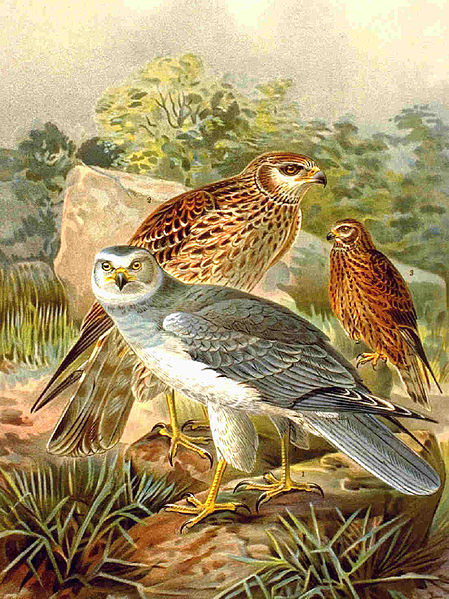
Hen Harrier (from the Wikimedia Commons)
An key part of grouse management involves predator management. According to research used by some of the shooting proponents, the survival of grouse and other species can be several times greater when predators are kept under control. For the unprotected predators such as the red fox, carrion crow, stoat or weasel this is a death sentence should they be caught on or near grouse lands.
A number of raptors also fall on a gamekeeper’s list of predators however most of these are protected species making it illegal to kill them or disturb them while nesting. With tradition, jobs and large sums of money on the line it is not surprising that the battle lines are drawn between the gamekeepers and other hunting proponents and the ‘raptor lobby’.
[Some interesting insight into the ‘Raptor Lobby’ can be obtained from the Raptor Persecution Scotland blog.]
When discussing Red Grouse management and raptors, one species that is frequently mentioned is the Hen Harrier (Circus cyaneus; the Northern Harrier in North America). The moorlands are a terrain well suited to their hunting and nesting behaviour yet, despite the laws intended to protect them they are disappearing in many areas of Britain particularly those areas near grouse moorlands. They and several other raptors including Golden Eagles and Buzzards are frequently shot or poisoned.
This year in England is especially ominous for the Hen Harrier. An August 9th article by the Royal Society for the Protection of Birds (RSPB) entitled: Hen harrier on the brink of ‘extinction’ in England reports that this is the first year since the 1960’s that the Harrier has not successfully nested in England (they mean ‘extirpation’ not extinction of course). The Hen Harrier, once widespread in Britain, has been harassed by gamekeepers for centuries. It was previously extirpated around 1900 only to resettle mid-century. Despite the raptor protection laws, the return to England is proving to be short lived and its future status may be uncertain as long as the economic value of the grouse hunt remains high. Given the economic importance of the grouse hunt, it is hardly surprising that Harriers and other protected raptors are being persecuted.
On the side of the hunt, a 2009 article in the Journal of Applied Ecology, Hen harriers and red grouse: economic aspects of red grouse shooting and the implications for moorland conservation, presents ecological and economic arguments to justify keeping Harrier populations low. It provides good insight into the economics of the grouse hunting industry and the issues facing the Harrier and other grouse predators.
Other opposing research is not as quick to blame the Harrier and other predators but instead lays out a number of other reasons for long term and year-to-year declines in grouse populations including: conversion of heather moorlands to sheep pastures; deterioration in the heather quality that grouse rely on for survival; increased disease reducing survival rate; increased predation by foxes and crows attracted by increased sheep populations; afforestation; and so on.
In an effort to find real solutions, both sides of the debate have cooperated in some long term research projects to better understand the relationship between grouse populations and raptors such as the Hen Harrier. A Joint Raptor Study (JRS) was run from 1992 to 1997 to measure the scale of raptor predation on grouse and the effects that would be felt on the hunt. A new study called The Langholm Moor Demonstration Project started in 2008 and will last up to 10 years with the goal of finding solutions to solve the grouse-raptor issues.
I won’t go into all the details of these studies but one interesting thing that I did learn which shows some of the complexity of the problem, is that the Harrier’s main prey are voles and meadow pipits, not the grouse, and the availability of these influences where the Harriers decide to settle in the spring. It is only during the months that they are breeding that grouse chicks are at risk of being taken and diversionary feeding (providing carrion to the raptors) has shown the numbers of grouse chicks taken to drop by as much as 86%.
Watching the Magician’s Other Hand
One fact which nobody disputes is that grouse are good for the environment.
That’s a direct quote from an obviously pro-hunt 1996 article published in “The Independent” and accurately sums up the position taken by most pro-hunt organizations.
Having spent some time trying to understand the history, culture and economics surrounding the grouse hunt in Great Britain, I can’t help feeling like I am watching a magician doing an elaborate trick when trying to sort through the shooters’ arguments. While their main hand attempts to capture my attention with statements of environmental and economic goodness, there other hand is quietly doing whatever it takes to make sure the grouse are ready on August 12.
The arguments for and against the grouse hunt and predator management are many and, sitting on the other side of the Atlantic, I don’t feel qualified to mark the scorecard. Instead, I will direct my final thoughts in a different direction going back to what drew me to write this in the first place, the name given to the opening of the Red Grouse hunting season.
Introspection
They call it the Glorious Twelfth.
Being a long-time fan of Star Trek the word glorious makes me think of the Klingons, warriors with tradition and a code of honour, their battles gloriously fought against enemies that are, they hope, worthy adversaries. The grouse hunt certainly has its tradition, however I wonder if a Klingon would feel glorious standing in a box waiting for someone else find and deliver their quarry to them, killing wave after wave of them with no chance of the quarry fighting back, the biggest risk coming from a neighbouring hunter? I wonder if they would feel any honour participating in a sport for which so many foxes, crows, stoats, weasels, other predators and even innocent creatures that had been killed, sometimes cruelly, in order to ensure the maximum number of grouse for the final slaughter?
The Glorious Twelfth doesn’t really do the day justice. Perhaps, as suggested by the birder and blogger Alan Tilmouth from Northumberland, a better name would be Hen Harrier Day.
References and Other Interesting Links
Some of the interesting links that I found while researching this article are given below. Some were used directly for information while others are just interesting reading.
Glorious Twelfth
Hunting
Shooting Trip Providers
In the Press
Game Conservation
Grouse, Hen Harriers and other Birds of Prey

 Some interesting links on the Lammergeier or Bearded Vulture that I found today starting with a link on BirdNote. This vulture is not a scavenger of meat but of bones and wait until you see how they deal with the bones. That’s one cool bird!

.jpg)


_-_geograph.org.uk_-_446843.jpg)

 Kevin's Nature Blog