Category Archives: Birds

Bird Migration Movie: Crossing the Gulf of Mexico

Ruby-throated Hummingbird

Ruby-throated Hummingbird by Matt Tillett (Flickr: Ruby-throated Hummingbird) [CC-BY-2.0], via Wikimedia Commons

 I found this hour long online movie about bird migration across the Gulf of Mexico a couple of days ago.  It does a good job of  documenting the amazing migration that many North American birds go through each Spring and Fall.  Birds as small as the Ruby-throated Hummingbird fly non-stop from the Yucatan to the Gulf coast of the US on their way to their breeding grounds further North, a trip that can take most of a day and cover 600 or more miles.  The fall sees a similar migration in the opposite direction back to the wintering grounds in Central and South America.

Link

Among my favourite birds to watch in flight are the swifts. They are powerful fliers that most people will only ever see on the wing since they cannot perch like the swallows that they superficially resemble (they are more closely related to hummingbirds).  A friend of mine recently brought a story a from Discover Magazine (This Bird Can Fly for Six Months Without Landing Once) to my attention. Equipping the some Alpine Swifts with motion sensing equipment, a group of Swiss researchers were able to show that the birds, which breed in the mountains from southern Europe to the Himalayas, can stay aloft for months at a time during their overwinter migration in southern Africa.

Amazing!

Link

The September  2013 issue of the Canadian online journal Avian Conservation & Biology features a number of short research articles associated with Quantifying Human-related Mortality of Birds in Canada.

Individual articles deal with the contributions from specific industries and activities including:

  • Vehicle Collisions
  • House Cats
  • Marine Commercial Fisheries
  • Offshore Oil and Gas Production
  • Industrial Forestry
  • Collisions with Buildings
  • Mowing and Other Operations in Agriculture
  • Oil and Gas Exploration in the Western Basin
  • Collisions and Habitat Loss from Wind Turbines.

All of the articles can be freely viewed online or by downloading a PDF version.

So, which one of the above categories do you think is the biggest contributor towards bird mortality?

The final article, A Synthesis of Human-related Avian Mortality in Canada, puts all the different sources of bird mortality into context.  Table 3 in this article shows bird mortality estimates separated by source and split into the categories of landbird, seabird, shorebird, waterbird and waterfowl.

And the biggest bird killer?  It is, by a long shot, the house cat with an estimated 135 million birds (almost exclusively landbirds) of which 80 million are attributed to feral cats and the remaining 55 million to the domestic variety.  Compare these numbers to the total of 186 million dead birds per year and we have house cats killing over 70% of all birds killed from human-related causes.

There’s a whole lot of interesting information in this issue.  Well worth a read.

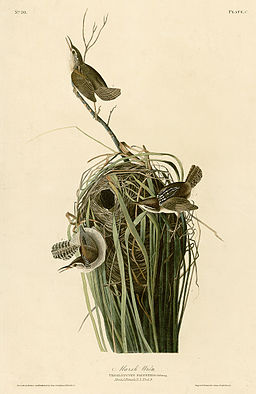
Hunting the Marsh Wren

100_Marsh_Wren_cropped (wiki commons)

Marsh Wren – John James Audubon [Public domain], via Wikimedia Commons

I have had a special interest in taking some good pictures of a Marsh Wren since a trip to the Cheam Lake Wetlands near Agassiz BC in late May. On that visit the Marsh Wrens were in peak singing form and I was barely out of my car when I heard the sounds of multiple wrens sparring in the marshy area a short distance from the parking lot.

Now I have read that Marsh Wrens like to sing from a prominent perch such as the top of a cattail. You can see this behaviour depicted, for example, in the drawing by John Audubon from around 1830. You would think then, with all the chattering, that I would have left with a picture or two. That day, however, I struck out. The wrens dove for cover before I could get close enough for a good shot.

Admittedly, I’m not one to stand around waiting for a bird to appear so my lack of success was partly my own fault. Besides, the male bird’s singing, heard almost constantly at that time of year, is distinctive enough for identification and counting.

Finally, a Cooperative Wren.

On one of my regular trips to Colony Farm Regional Park on August 22 I finally found a cooperative Marsh Wren.

Juvenile WrenNot far from the pump-house I came across a small brown bird in the middle of the gravel path taking a dust bath. My first thought was a juvenile Marsh Wren which I confirmed a few days later with the help of an online bird identification forum.  It clearly spotted me but seemed confident enough (the boldness of youth perhaps) that as long as I kept my distance, it would not run for cover.

It’s movements were incredibly swift and it could go from one resting position watching me to another in a fraction of a second with.  The following 4 sequences of pictures were taken in burst mode with 1/5 of a second between consecutive frames.  The first 3-frame sequence, for instance covered a period of just 0.4 seconds during which the wren went from sitting facing right, to sitting facing left following a roll-manoeuver onto its side.

Juvenile Wren Composite #1 (447-449)

In the next 1.0 second sequence the wren finishes a roll, watches me for almost half a second and then goes into another roll with my final image catching it just when it was on its back.

Wren Composite #2 (451-456)

Here is another 0.6 second clip showing a sequence of watch – roll – watch – roll.

Wren Composite #3 (462-465)

Lastly, one final 0.6 second sequence of watching with a 90 degree twist.

Wren Composite #4 (470-473)

The little wren was definitely cute and put on a good show.  In retrospect, I should have used the camera to create a short video to show its incredibly quick movements.  I still want to get pictures of an adult Marsh Wren though this may have to wait for 2014.

The Marsh Wren is definitely an interesting bird to watch and to listen to.  As a song bird, some western individuals have been known to learn and sing over 200 songs which are learned from other wrens and, in some cases, from other species as well.  Here is a recording that I made on June 5 of a duet between a Marsh Wren and a Gray Catbird.  If you listen carefully, in the last 10 seconds you can hear the catbird mimicking some of the wren’s song phrases.  Note that this recording was made almost the exact location where I photographed this immature wren which could conceivably be the singing wren’s offspring.

Marsh Wren – The Dark Side

If you read up on the Marsh Wren species the are a few behaviours that the species is known for. One is polygyny and it is not uncommon for a single male to breed with multiple females.  During nest building, the male may actually make as many as 10 nests even though a courting female will ultimately only choose one. Of course, if the wren takes more than one mate one is clearly not enough. The remainder go unused though some speculate that they may get for refuge by fledged birds during a storm or if the first nest fails.

A second behaviour that the Marsh Wren is known for is egg destruction.  Both male and female birds will destroy eggs and even hatchlings in nests close to their territory if given the chance.  This includes eggs in other Marsh Wren nests.  This is undoubtedly an evolutionary strategy that helps remove competition  for food and nesting sites.

This behaviour, not unexpectedly, has earned the Marsh Wren several enemies. Two of the principal ones are the Red-winged and Yellow-headed Blackbirds that frequently inhabit the same types of environments during breeding season. The larger blackbirds will frequently chase the wrens trying to drive them out of the area. There are reports of Yellow-headed blackbirds hopping on wren nests to destroy them or blocking the entrance to a nest to prevent a female Marsh Wren from returning to their brood.

The Marsh Wren is a bird with lots of personality that is definitely one of my favourites.

References

[1] Kroodsma, Donald E. and Jared Verner. 1997. Marsh Wren (Cistothorus palustris), The Birds of North America Online (A. Poole, Ed.). Ithaca: Cornell Lab of Ornithology; Retrieved from the Birds of North America Online: http://bna.birds.cornell.edu/bna/species/308; doi:10.2173/bna.308

Vultures: They came, They ate, They died.

By Joachim Huber [CC-BY-SA-2.0], via Wikimedia Commons

By Joachim Huber (cropped) [CC-BY-SA-2.0], via Wikimedia Commons


Last week I came across an article in Raptor Politics linking to an August 29 article in National Geographic that has me totally bummed out.

We have all heard stories about elephant poachers who kill African elephants for the ivory in their tusks. Apparently, because the flocks of vultures that arrive rapidly on the scene can sometimes give away the position of the poachers, they have taken to poisoning the elephant carcasses.

The vultures come. The vultures eat. The vultures die.

In one case an estimated 600 vultures died for the two tusks taken from the carcass of a single elephant. This death toll doesn’t include dependent young that may have starved to death or fallen prey to other predators.

In recent years, the illegal ivory trade appears to be in state of increasing demand and decreasing supply despite a 1990 international treaty banning the trade in ivory. According to a May 2010 Associated Press article, published at SFGate.com (Ivory black market threatens the elephant) from 2002 to 2010, the price of ivory in some Asian markets rose from $100/kg to about $1800/kg. A January 2013 BBC article (African elephant poaching threatens wildlife future) describes traders selling tusks for $400/kg. No wonder elephant poaching is accelerating and increasingly more dangerous. As the stakes rise the poachers are better armed and willing to take bigger risks. The result may be the disappearance of the African elephant from the wild, perhaps in our lifetime. Worse still, this is also coming with a significant by-catch that may result in the disappearance of other animals such as several endangered species of vultures.

It is very easy to feel depressed reading about the elephants and vultures being slaughtered for simple greed. It is much more difficult trying to come up with solutions that might help stem the illegal ivory trade and protect both elephant and vulture. Here are some that come to mind:

  1. Get rid of the poachers. How this is done is a good question. If you read the comments to the National Geographic article there appears to be little sympathy for these poachers. Some groups tasked with protecting wildlife in Africa, such as park rangers, appear to have unofficial policies of just shooting first and asking questions later. A big problem is that many African countries do not have he resources or willpower to deal with poachers. In some countries the wild populations of elephants are already gone while in others, the lack of protection probably means extirpation there as well.
  2. The poachers are after the ivory in the tusks so just remove the tusks. This is not an ideal solution but in the short term might provide some reprieve. I am not an elephant expert and do not know how this would affect either elephant social behaviour or even their ability to survive. Nonetheless, a tusk-less elephant is, it would seem, preferable to a dead elephant and subsequent generations of elephants could sport them in the future when it was safe to do so. The logistics of performing this operation on elephants on a large scale would probably be challenging.
  3. Taint that tusks to make the ivory less valuable. Perhaps drilling holes and refilling with something like an epoxy so that they retain their strength. Perhaps something can be sprayed on them that discolours the ivory down into the tusk’s core. You would want to discolour the tusks in any case to make sure hunters could tell that they were worthless before they shoot and kill the.
  4. Make the penalty for any dealing in illegal ivory more severe. The 1990 treaty banning trade in ivory allows for legitimate trade in “old” pre-treaty ivory which opens up the door to counterfeiting. Some countries are cracking down more on illegal trade though it is probably not enough.
  5. Make it unfashionable to have ivory products. The elephants may not survive long enough for this solution however.

With the majority of the illegal ivory trade residing in several Asia countries led by China, the problem may seem far away. A 2008 National Geographic article (U.S. One of Largest Ivory Markets, New Study Says), however, shows that the richer Western nations also share some of the responsibility for these massacres.

References

Here is a list of reference that were used in writing this article or that are interesting for further reading.

[1] Raptor Politics (2013-09-11): The Slaughter of African Elephants and Vultures reported out of control

[2] National Geographic (2013-08-29): Elephant Poachers Poison Hundreds of Vultures to Evade Authorities

[3] BBC News Africa (2013-09-11): Can we learn to love vultures?

[4] National Geographic (2008-05-05): U.S. One of Largest Ivory Markets, New Study Says

[5] SFGate article – Michael Casey, William Foreman and Jason Straziuso, Associated Press (2010-05-23): Ivory black market threatens the elephant

[6] BBC News Africa (2013-01-14): African elephant poaching threatens wildlife future

[7] Wikipedia: Ivory Trade

It’s Taxa Time and Time to Audit your Sage Sparrow Sightings

According to this article which was front-page on the eBird.org home page today (2013-09-12), over the next few days eBird is updating their database to adjust for this year’s modifications to bird taxonomy.  Some of the changes are pretty extensive but most do not appear to affect the ABA area.  The one that does is the Sage Sparrow which is being split into 2 species: Sagebrush Sparrow and Bell’s Sparrow (formerly a subspecies).  Check your records (I found a single Sage Sparrow sighting from December 2002).