Author Archives: KevinHHood

Link

The September  2013 issue of the Canadian online journal Avian Conservation & Biology features a number of short research articles associated with Quantifying Human-related Mortality of Birds in Canada.

Individual articles deal with the contributions from specific industries and activities including:

  • Vehicle Collisions
  • House Cats
  • Marine Commercial Fisheries
  • Offshore Oil and Gas Production
  • Industrial Forestry
  • Collisions with Buildings
  • Mowing and Other Operations in Agriculture
  • Oil and Gas Exploration in the Western Basin
  • Collisions and Habitat Loss from Wind Turbines.

All of the articles can be freely viewed online or by downloading a PDF version.

So, which one of the above categories do you think is the biggest contributor towards bird mortality?

The final article, A Synthesis of Human-related Avian Mortality in Canada, puts all the different sources of bird mortality into context.  Table 3 in this article shows bird mortality estimates separated by source and split into the categories of landbird, seabird, shorebird, waterbird and waterfowl.

And the biggest bird killer?  It is, by a long shot, the house cat with an estimated 135 million birds (almost exclusively landbirds) of which 80 million are attributed to feral cats and the remaining 55 million to the domestic variety.  Compare these numbers to the total of 186 million dead birds per year and we have house cats killing over 70% of all birds killed from human-related causes.

There’s a whole lot of interesting information in this issue.  Well worth a read.

Hunting the Marsh Wren

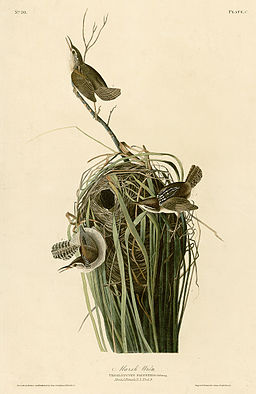
100_Marsh_Wren_cropped (wiki commons)

Marsh Wren – John James Audubon [Public domain], via Wikimedia Commons

I have had a special interest in taking some good pictures of a Marsh Wren since a trip to the Cheam Lake Wetlands near Agassiz BC in late May. On that visit the Marsh Wrens were in peak singing form and I was barely out of my car when I heard the sounds of multiple wrens sparring in the marshy area a short distance from the parking lot.

Now I have read that Marsh Wrens like to sing from a prominent perch such as the top of a cattail. You can see this behaviour depicted, for example, in the drawing by John Audubon from around 1830. You would think then, with all the chattering, that I would have left with a picture or two. That day, however, I struck out. The wrens dove for cover before I could get close enough for a good shot.

Admittedly, I’m not one to stand around waiting for a bird to appear so my lack of success was partly my own fault. Besides, the male bird’s singing, heard almost constantly at that time of year, is distinctive enough for identification and counting.

Finally, a Cooperative Wren.

On one of my regular trips to Colony Farm Regional Park on August 22 I finally found a cooperative Marsh Wren.

Juvenile WrenNot far from the pump-house I came across a small brown bird in the middle of the gravel path taking a dust bath. My first thought was a juvenile Marsh Wren which I confirmed a few days later with the help of an online bird identification forum.  It clearly spotted me but seemed confident enough (the boldness of youth perhaps) that as long as I kept my distance, it would not run for cover.

It’s movements were incredibly swift and it could go from one resting position watching me to another in a fraction of a second with.  The following 4 sequences of pictures were taken in burst mode with 1/5 of a second between consecutive frames.  The first 3-frame sequence, for instance covered a period of just 0.4 seconds during which the wren went from sitting facing right, to sitting facing left following a roll-manoeuver onto its side.

Juvenile Wren Composite #1 (447-449)

In the next 1.0 second sequence the wren finishes a roll, watches me for almost half a second and then goes into another roll with my final image catching it just when it was on its back.

Wren Composite #2 (451-456)

Here is another 0.6 second clip showing a sequence of watch – roll – watch – roll.

Wren Composite #3 (462-465)

Lastly, one final 0.6 second sequence of watching with a 90 degree twist.

Wren Composite #4 (470-473)

The little wren was definitely cute and put on a good show.  In retrospect, I should have used the camera to create a short video to show its incredibly quick movements.  I still want to get pictures of an adult Marsh Wren though this may have to wait for 2014.

The Marsh Wren is definitely an interesting bird to watch and to listen to.  As a song bird, some western individuals have been known to learn and sing over 200 songs which are learned from other wrens and, in some cases, from other species as well.  Here is a recording that I made on June 5 of a duet between a Marsh Wren and a Gray Catbird.  If you listen carefully, in the last 10 seconds you can hear the catbird mimicking some of the wren’s song phrases.  Note that this recording was made almost the exact location where I photographed this immature wren which could conceivably be the singing wren’s offspring.

Marsh Wren – The Dark Side

If you read up on the Marsh Wren species the are a few behaviours that the species is known for. One is polygyny and it is not uncommon for a single male to breed with multiple females.  During nest building, the male may actually make as many as 10 nests even though a courting female will ultimately only choose one. Of course, if the wren takes more than one mate one is clearly not enough. The remainder go unused though some speculate that they may get for refuge by fledged birds during a storm or if the first nest fails.

A second behaviour that the Marsh Wren is known for is egg destruction.  Both male and female birds will destroy eggs and even hatchlings in nests close to their territory if given the chance.  This includes eggs in other Marsh Wren nests.  This is undoubtedly an evolutionary strategy that helps remove competition  for food and nesting sites.

This behaviour, not unexpectedly, has earned the Marsh Wren several enemies. Two of the principal ones are the Red-winged and Yellow-headed Blackbirds that frequently inhabit the same types of environments during breeding season. The larger blackbirds will frequently chase the wrens trying to drive them out of the area. There are reports of Yellow-headed blackbirds hopping on wren nests to destroy them or blocking the entrance to a nest to prevent a female Marsh Wren from returning to their brood.

The Marsh Wren is a bird with lots of personality that is definitely one of my favourites.

References

[1] Kroodsma, Donald E. and Jared Verner. 1997. Marsh Wren (Cistothorus palustris), The Birds of North America Online (A. Poole, Ed.). Ithaca: Cornell Lab of Ornithology; Retrieved from the Birds of North America Online: http://bna.birds.cornell.edu/bna/species/308; doi:10.2173/bna.308

Vultures: They came, They ate, They died.

By Joachim Huber [CC-BY-SA-2.0], via Wikimedia Commons

By Joachim Huber (cropped) [CC-BY-SA-2.0], via Wikimedia Commons


Last week I came across an article in Raptor Politics linking to an August 29 article in National Geographic that has me totally bummed out.

We have all heard stories about elephant poachers who kill African elephants for the ivory in their tusks. Apparently, because the flocks of vultures that arrive rapidly on the scene can sometimes give away the position of the poachers, they have taken to poisoning the elephant carcasses.

The vultures come. The vultures eat. The vultures die.

In one case an estimated 600 vultures died for the two tusks taken from the carcass of a single elephant. This death toll doesn’t include dependent young that may have starved to death or fallen prey to other predators.

In recent years, the illegal ivory trade appears to be in state of increasing demand and decreasing supply despite a 1990 international treaty banning the trade in ivory. According to a May 2010 Associated Press article, published at SFGate.com (Ivory black market threatens the elephant) from 2002 to 2010, the price of ivory in some Asian markets rose from $100/kg to about $1800/kg. A January 2013 BBC article (African elephant poaching threatens wildlife future) describes traders selling tusks for $400/kg. No wonder elephant poaching is accelerating and increasingly more dangerous. As the stakes rise the poachers are better armed and willing to take bigger risks. The result may be the disappearance of the African elephant from the wild, perhaps in our lifetime. Worse still, this is also coming with a significant by-catch that may result in the disappearance of other animals such as several endangered species of vultures.

It is very easy to feel depressed reading about the elephants and vultures being slaughtered for simple greed. It is much more difficult trying to come up with solutions that might help stem the illegal ivory trade and protect both elephant and vulture. Here are some that come to mind:

  1. Get rid of the poachers. How this is done is a good question. If you read the comments to the National Geographic article there appears to be little sympathy for these poachers. Some groups tasked with protecting wildlife in Africa, such as park rangers, appear to have unofficial policies of just shooting first and asking questions later. A big problem is that many African countries do not have he resources or willpower to deal with poachers. In some countries the wild populations of elephants are already gone while in others, the lack of protection probably means extirpation there as well.
  2. The poachers are after the ivory in the tusks so just remove the tusks. This is not an ideal solution but in the short term might provide some reprieve. I am not an elephant expert and do not know how this would affect either elephant social behaviour or even their ability to survive. Nonetheless, a tusk-less elephant is, it would seem, preferable to a dead elephant and subsequent generations of elephants could sport them in the future when it was safe to do so. The logistics of performing this operation on elephants on a large scale would probably be challenging.
  3. Taint that tusks to make the ivory less valuable. Perhaps drilling holes and refilling with something like an epoxy so that they retain their strength. Perhaps something can be sprayed on them that discolours the ivory down into the tusk’s core. You would want to discolour the tusks in any case to make sure hunters could tell that they were worthless before they shoot and kill the.
  4. Make the penalty for any dealing in illegal ivory more severe. The 1990 treaty banning trade in ivory allows for legitimate trade in “old” pre-treaty ivory which opens up the door to counterfeiting. Some countries are cracking down more on illegal trade though it is probably not enough.
  5. Make it unfashionable to have ivory products. The elephants may not survive long enough for this solution however.

With the majority of the illegal ivory trade residing in several Asia countries led by China, the problem may seem far away. A 2008 National Geographic article (U.S. One of Largest Ivory Markets, New Study Says), however, shows that the richer Western nations also share some of the responsibility for these massacres.

References

Here is a list of reference that were used in writing this article or that are interesting for further reading.

[1] Raptor Politics (2013-09-11): The Slaughter of African Elephants and Vultures reported out of control

[2] National Geographic (2013-08-29): Elephant Poachers Poison Hundreds of Vultures to Evade Authorities

[3] BBC News Africa (2013-09-11): Can we learn to love vultures?

[4] National Geographic (2008-05-05): U.S. One of Largest Ivory Markets, New Study Says

[5] SFGate article – Michael Casey, William Foreman and Jason Straziuso, Associated Press (2010-05-23): Ivory black market threatens the elephant

[6] BBC News Africa (2013-01-14): African elephant poaching threatens wildlife future

[7] Wikipedia: Ivory Trade

It’s Taxa Time and Time to Audit your Sage Sparrow Sightings

According to this article which was front-page on the eBird.org home page today (2013-09-12), over the next few days eBird is updating their database to adjust for this year’s modifications to bird taxonomy.  Some of the changes are pretty extensive but most do not appear to affect the ABA area.  The one that does is the Sage Sparrow which is being split into 2 species: Sagebrush Sparrow and Bell’s Sparrow (formerly a subspecies).  Check your records (I found a single Sage Sparrow sighting from December 2002).

Lammergeier or Bearded Vulture – One Cool Bird

Bartgeier Gypaetus barbatus front Richard BartzSome interesting links on the Lammergeier or Bearded Vulture that I found today starting with a link on BirdNote.  This vulture is not a scavenger of meat but of bones and wait until you see how they deal with the bones.  That’s one cool bird!

BirdNote: Gerrit Vyn on the Lammergeier

AnimalPlanet: Birds of Prey – Lammergeier

BBC/YouTube: Wild African vulture birds scavenge bones of dead animals – BBC wildlife

Bearded Vulture Project (Southern Africa)

Hellenic Ornithological Society (European status)

ABA Bird #981 – the Nutmeg Mannikin

Nutmeg Mannikin 1The September 7 post ABA Adds Nutmeg Mannikin, #981 by the ABA blogger Bill Pranty, announced the acceptance of species #981, the Nutmeg Mannikin, to the list of ABA countable species.  According to the California Bird Records Committee (CBRC) the Nutmeg Mannikin is an established species in certain regions of California which, in the end, was good enough for ABA acceptance.  It can now be counted but only in those regions.

When we lived in Southern California we knew of this bird’s existence through the short entry on a page of exotic finches near the back of our first edition copy of The Sibley Guide to Birds published in 2000.  We never actually saw one of these while we lived there (we left in 2005) but we did eventually see one on a vacation to the island of Kaua’I in 2012.  They have been long established on the Hawaiian Islands having been introduced in 1866 [Ref 2] and are on the AOU checklist which includes Hawai’i.  Even though most of the rest of the world recognizes this species by the name Scaly-breasted Munia, the ABA has the tradition of using the AOU name first if available.  Bill Pranty in his post hints that an AOU name change could eventually result in a change to the more widespread name that is also the name recognized by the International Ornithologists’ Union [Ref 4].

I tried to find out where the alternate name of Nutmeg Mannikin came from but have so far been unsuccessful.  All I have been able to discover is that in the pet trade the more common names are Nutmeg Mannikin or Spice Finch. If anyone knows the answer I would love to find out.

If you want more information on the Nutmeg Mannikin, take a look at Bill Pranty’s blog article.  It has lots more information and useful links.  I now have one more bird to look for on my next visit to Southern California.

Nutmeg Mannikins In Birdfeeder

References and Other Links

[1] ABA Adds Nutmeg Mannikin, #981; 2013-09-07 ABA blog posting by Bill Pranty.

[2] Monograph: Nutmeg Mannikin, from the Bishop Museum (http://hbs.bishopmuseum.org).

[3] Houston Audubon Birding: Nutmeg Mannikin (Lonchura punctulata).  This link has an identification chart showing a juvenile mannikin photographed weekly until it reached adult plumage.  I wish that I could have such a chart for all birds in my area.

[4] International Ornithologists’ Union: World Bird List.

[5] Wikipedia: Scaly-breasted Munia.

Roger Tory Peterson

Yesterday, August 28, was the 105-th anniversary of the birth of Roger Tory Peterson one of the most influential naturalists of the 20-th century.  Born in 1908 in Jamestown New York, his first book, Field Guide to the Birds was published in 1934 when he was only 26, and helped make bird identification accessible to the general public.

The Roger Tory Peterson Institute (RTPI) was founded in Jamestown to continue his work.  Their website has a excellent short biography of RTP which highlights his accomplishments and shows just how important his work was to the environmental movement of the 20-th century.

Links

Roger Tory Peterson Institute of Natural History (RTPI): Biography of Roger Tory Peterson.

BirdNote: Happy Birthday, Roger Tory Peterson.

UK’s Blogging Red Kites

Blogging Birds is the name of a web-site run by a group of researchers at the University of Aberdeen in Scotland in conjunction with members of the RSPB (Royal Society for the Protection of Birds). The site’s byline, The lives of red kites, told by computers, sums up what the site is all about.

Red Kites 5 (5939879892) The Red kite is a species of raptor that, according to the web site, was once widespread in the UK and, after having been almost extirpated (down to 10 breeding pairs in Wales in the 1940’s) is making something of a comeback.

What the researchers have done is to fit several birds with satellite transmitters that provide accurate positions for the birds several times per day. These can be plotted on a map which anyone can see online. So far, pretty cool, but there’s more!

In addition to the geo-tracking, the researchers have linked in information from other databases that tell them about the areas visited by the birds. They know if an area is urban or rural and, based on land use information, can guess at how a bird might be feeding itself. They also know when a kite is near its home turf or if it is exploring far outside its normal range. Finally, if their path crosses that of one of the other tracked kites, they have information about their possible interactions with others of their species.

The final piece that let’s them create blog postings on behalf of the kites is something called Natural Language Generation which synthesizes all the data with known kite behaviour and spits out the weekly computer generated postings that anyone can see. Looking at the web-site today I see that they have four blogs on tap for the kites: Wyvis, Moray, Millie and Ussie. There appear to be other tracked kites as well with one of them, Beauly, mentioned in Millie‘s latest post for the week of August 12 to 18.

It will be interesting to follow one or more of the kites over longer periods of time. Perhaps these blogs can help to reduce the animosity that once almost led to the Red Kite’s extirpation from the British Isles.

Notes

Of the three most common North American kites, the Red Kite is closest taxonomically to the Mississippi Kite of the south-eastern US sharing the same sub-family (Milvinae) but different genera. The White-tailed and Swallow-tailed Kites are both from a different sub-family (Elaninae). All of these kites are from the family Accipitridae of diurnal birds of prey.

The related species of Black Kite is sometimes seen in England, usually during migration. Both it and the Red Kite are from the same genus Milvus and have been known to hybridize.